Mainnavigation
Subnavigation
BORDER
Pagecontent
- You are here:
- Home »
- MLDesigner »
- Examples »
- Networking Applications »
- Satellite-based WAN Back-up
Satellite-based WAN Backup
Performance level analysis of satellite based Wide Area Network (WAN) using MLDesigner and SatLab
This combined MLDesigner/SatLab application models the operation of a reliable Wide Area Network system with an automated satellite-based back-up system. The WAN connects three sites in the US: San Francisco, New York and Dallas. Each site has a co-located satellite ground station and automatic monitoring of the terrestrial WAN links. If a link breaks traffic is buffered and then automatically switched to a satellite link. When the terrestrial link is restored, traffic is rerouted to that link and the satellite link is closed.
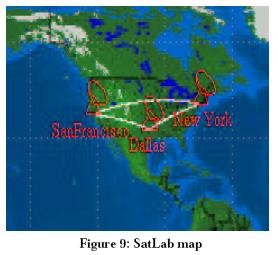
All network operations and the terrestrial links are modeled in MLDesigner. SatLab provides continuous satellite positions relative to the ground stations and provides an animated display of the ground stations and links.
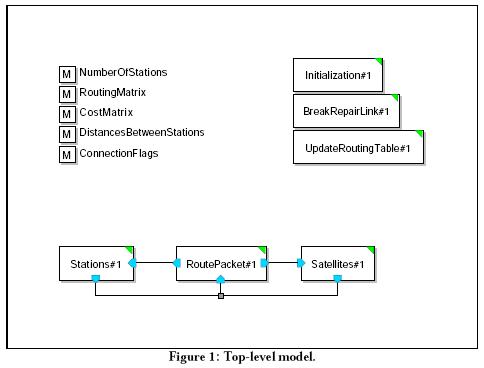
The top-level model is shown below in Figure 1.
The top-level system model consists of three main blocks representing stations, routers and satellites. There are three support blocks?an initialization block, a block to break and repair links, and a router table update block.
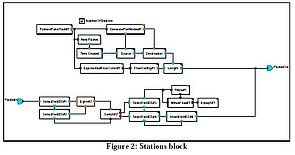
The stations block (Fig. 2) generates packets for all stations, assigns source and destination addresses, and sends them to the router. The stations block also receives packets for all stations from the router block and collects the total transit time for each packet.
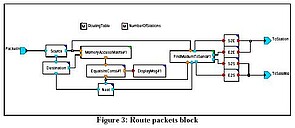
The route packet (Fig.3) block receives packets from a station or a satellite, checks the destination and the available links and routes the packet to either the destination station or a satellite.
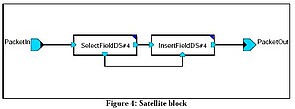
The satellite block (Fig. 4) receives packets from the router, updates the destination address, and sends the packet back to the router.
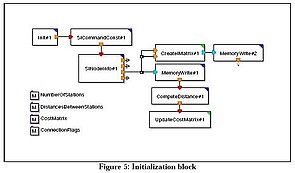
The initialization block (Fig.5) establishes contact with SatLab and generates data tables used by the simulation.
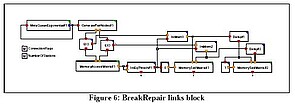
The BreakRepair link block (Fig.6) randomly breaks and repairs the terrestrial links and provides information on alternative links.
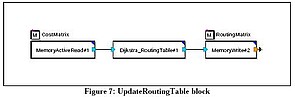
The UpdateRoutingTable block (Fig.7) updates the routing table using data from the BreakRepair link block and writes the updated table to memory so it is available to the router.
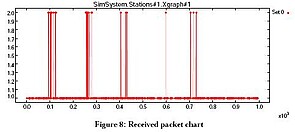
This table (Fig.8) shows the transit time for packets. The packets traveling the satellite link have a longer delay.
The critical portion of the SatLab simulation map is shown below (Fig.9).